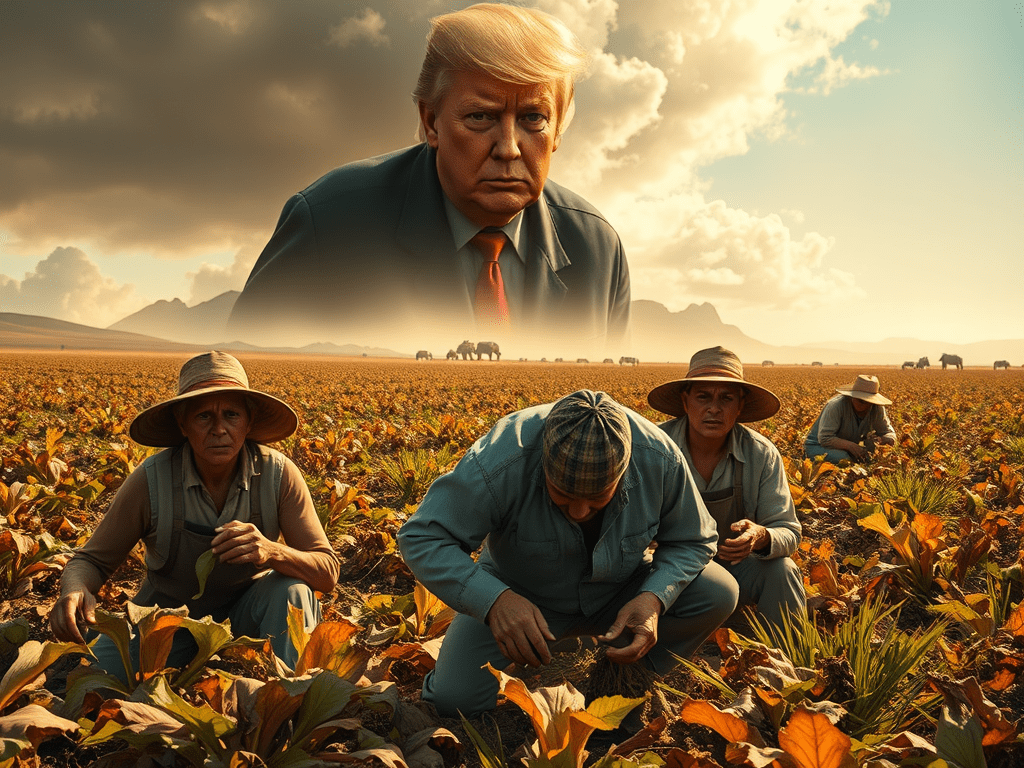
America, my friend, is a country of contradictions. We love cheap, but hate the people who make it so. Our dear leaders worship “family values,” but can’t be bothered to care about the migrant families who keep our grocery stores and pantries stocked. And now, under the grand wizardry of Donald Trump’s immigration policy, we’ve reached peak insanity: threatening the very people who grow and harvest the food we eat to live.
California—our nation’s breadbasket, salad bowl, and nut case all rolled into one—is in trouble. The state’s agricultural fields rely on migrant workers, often undocumented, who are now terrified to show up for work. Why? Because they’re being hunted like extras in some dystopian Hunger Games sequel. The Trump Administration calls them “illegals,” but we call them essential—at least when we’re stuffing our faces with fried avocado egg rolls at Cheesecake Factory or sucking down olives and guacamole on game day.
THE FARMING APOCALYPSE: ROT AND RUIN
The numbers don’t lie, folks. California grows more than a half of America’s food, which includes your rice, vegetables, and two-thirds of your fruits and nuts (USDA). Farmers are screaming for help, but nobody’s listening. And without farm workers? Crops are going to rot in the fields like forgotten corpses in a war zone.
Let me spell this out for the folks in the back: no workers, no food. And for the likes of Elon Musk: You can’t automate harvesting strawberries or lettuce. Drones don’t inspect cows or milk them. As of today, Tesla doesn’t make a self-driving, grain-harvester that allows the driver to sleep while wiping out a small herd of living creatures—yet.
The farm labor shortage is already dire. In 2024, more than 384,000 agricultural jobs were filled through the H-2A visa program, an increase from the year before (American Farm Bureau Federation). That’s how desperate farmers are for farm workers: they’re relying on a bureaucratic program so clunky it has all the charm and efficiency of assembling IKEA furniture without instructions—or the little wrench. In all seriousness, these numbers are a reflection of crisis-level labor shortages in a life-essential profession.
But even that won’t be enough if migrant workers stay scared away by deportation threats. And who can blame them? ICE isn’t exactly handing out welcome mats—they’re handing out one-way tickets out of the country. Over 271,000 deportations last year alone, and this year they’re off to a roaring start with over 1,000 arrests in just two days. It’s like they’re playing some twisted reality show: Deportation Olympics: How Fast Can You Clear a Field of Workers?
If migrant farm workers get deported, who’s going to pick la fruta del diablo (the fruit of the devil)—a name migrant farm workers have given the strawberry because of the backbreaking labor involved harvesting it cripples one before age 30?
“Working in the fields is hard, but working in the strawberry fields is the hardest.”
Farm Worker, Age 38
Strawberry plants aren’t exactly towering giants—they’re 4 or 5 inches tall, stuck in beds 8 to 12 inches high, just waiting to destroy your back. To pick the damn things, workers have to bend over from the waist for 10 to 12 hours straight. And don’t think it’s just about muscle—oh no, it’s a goddamn ballet of pain. You’re pulling berries that are softer than a politician’s promises, delicate as a trust fund baby’s ego. One wrong move, and you’ve got a bruised mess of red fruit. Only the perfect berries get picked—the right size, shape, firmness, and color. It’s not enough to just bend down and yank a berry; these workers have to make it look good for the customer, arranging each berry like it’s a piece of fragile art. But that’s not all—while you’re making your back hate you, you’re also tending plants, checking irrigation, tossing out rotting fruit to keep the rest from spoiling.
In 2022, farm workers in Mexico earned less than $1.59 per hour. But here’s the kicker: by crossing the border and working in the U.S., Mexican H-2A migrant farm workers can earn in one hour what they’d make in an entire day back home—thanks to California’s Adverse Effect Wage Rate (AEWR), which is set at $19.97 per hour.
While the wage disparity is shocking, it’s not as rosy as it may seem—some farm workers are paid by piece, load or production (i.e., per bushel, per pound, per truck, etc.), which can mean earning less than established minimum wage laws.
But don’t get too cozy. It’s not all sunshine and roses—it’s a nonstop grind of precision, sweat, and crippling back pain. And don’t think it’s all about those fat hourly wages. Sometimes, they’re paid by production, which, more often than not, ends up being a hell of a lot less than minimum wage. So much for a “living wage,” right?”
So, to the great thinkers recently appointed in Washington, D.C. to represent the people, I ask, “who’s gonna harvest the rice, almonds, olives, onions, tomatoes, beans, broccoli, lettuce, cabbage, and avocados? You? Me?” Yeah, right.
Farmers, particularly California farmers, are staring down a nightmare where crops rot in the fields, and grocery stores turn into post-apocalyptic wastelands. Let me paint a picture for you; wilting lettuce at $29 per head. A tomato for $10. Your eggs are already rival or surpass $12 dollars per carton at the grocery store—that is $1 for something that shoots out of a chicken’s ass. In case you didn’t know, California grows nearly all of Japan’s rice—more than 70 percent, and California is responsible for about a third of the rice consumed right here in the United States making rice a primary market for California and U.S. rice farmers. You want rice so expensive it might as well come with a side of shame and regret? That’s not hyperbole, folks—that’s the brutal reality of gutting your labor force and expecting the food to harvest itself. But hey, at least we’ll have fewer people to blame. That’ll fix everything, right? d
California, the golden child of America’s food supply, is responsible for pumping out a huge chunk of the nation’s fruits, veggies, rice, and nuts—and it’s all built on the backs of migrant workers.
If our hard-working farm laborers either get deported or simply don’t apply for work out of deportation fear , the fallout on U.S. agriculture will be catastrophic—and it’s gonna last a hell of a long time. California, the golden child of America’s food supply, is responsible for pumping out a huge chunk of the nation’s fruits, veggies, rice, and nuts—and it’s all built on the backs of migrant workers. And let’s be real—the politicians who just got elected? They’re not working on a damn thing to fix the massive shortage of farm workers that’s about to hit us. That means crops are gonna rot in the fields, and your grocery bill? Yeah, that’s gonna get ugly. When produce prices skyrocket and rice production nosedives, everything’s gonna feel the pinch. This is a chain reaction, folks—supply drops, prices go up, and it’s not just your avocado toast that’s gonna cost a fortune. It’s gonna be everything
The current deportation numbers highlight the urgency of addressing this issue to prevent a potential crisis in the nation’s food supply.
So, I ask you … Eggs? Twenty bucks a dozen by Thanksgiving. Lettuce? You’ll need to auction off a kidney for a head of it. Onions? Forget it—they’ll be worth more than your Tesla. Almonds? Try $100 a pound, and pray you’re not addicted to almond milk.
While we’re not yet living in a Mad Max world, the situation is teetering on the edge of collapse, and the consequences are closer than we think.
HUNGER GAMES: THE REAL EDITION
Here’s the really fun part: nobody’s paying attention. Americans are too busy binge-watching reality TV to notice the looming famine. But don’t worry, they’ll wake up when their breakfast burritos cost $85 and their Big Mac comes with a side of moral regret.
Happy Hunger Games, and may the odds be ever in your favor.
Elizabeth Banks as Effie Trinket, Hunger Games (2012)
By Thanksgiving, the fields will be left fallow, the grocery shelves bare, food-prices sky-high. The crisis will be impossible to ignore because hunger does strange things to people. Imagine middle-class … sorry, almost forgot middle-class has not existed for a while now … wealthy suburbanites swapping out drug dealers for restaurant produce suppliers and members of Costco storming the warehouses, not unlike the people stormed the Bastille during the French Revolution, but here they’ll be demanding the likes of rice, beans, cereal, avocados, artisanal kale, and heirloom tomatoes.
It’s coming, folks, and it’s going to get ugly.
THE AMERICAN HYPOCRISY
The irony is so thick you could spread it on toast—if you could still afford toast, that is. On the whole, most Americans hate paying higher prices for organic produce, and sure as hell love a $1 value menu burger. Americans want cheap food, but not the immigrants who make it possible. It’s a double-standard so massive it should have its own zip code.
Trump and his ilk call it “taking back America.” But what they’re really taking back is your dinner. This isn’t patriotism—it’s masochism. The kind of short-sighted, self-destructive thinking that’ll have you eating Spam casseroles for dinner this Christmas—because that’s either all you saved in the pantry during “the before time” or all you can afford in the very near future.
FINAL WORD: THE PRICE OF IGNORANCE
Here’s the truth: without farms, farmers, and farm workers, America doesn’t eat. California’s farms don’t magically harvest themselves. And when this crisis hits full swing—when the food riots start and back-alley bean dealers become the new normal—maybe then people will realize what they’ve done. Or maybe not. Maybe they’ll just blame someone else, because that’s the American way.
So buckle up, folks. The Great American Hunger Games are about to begin—and your $85 guacamole might just be the least of your worries.
Sources:
- USDA: California agriculture statistics
- American Farm Bureau Federation: Data on farm labor shortages and H-2A visas
- The Washington Times: ICE arrests more than 1,000 illegal immigrants over two days
- ABC News: ICE removed largest number of people in US illegally since 2014: Report
- MJ DOA Magazine: Challenges in California farm labor shortages
- El País: Migrant labor fears in California agriculture
- Farm Bureau – Debunking H-2A Myths: Understanding the Reality of Farm Labor Needs
 TheSignal.Report
Leave a comment