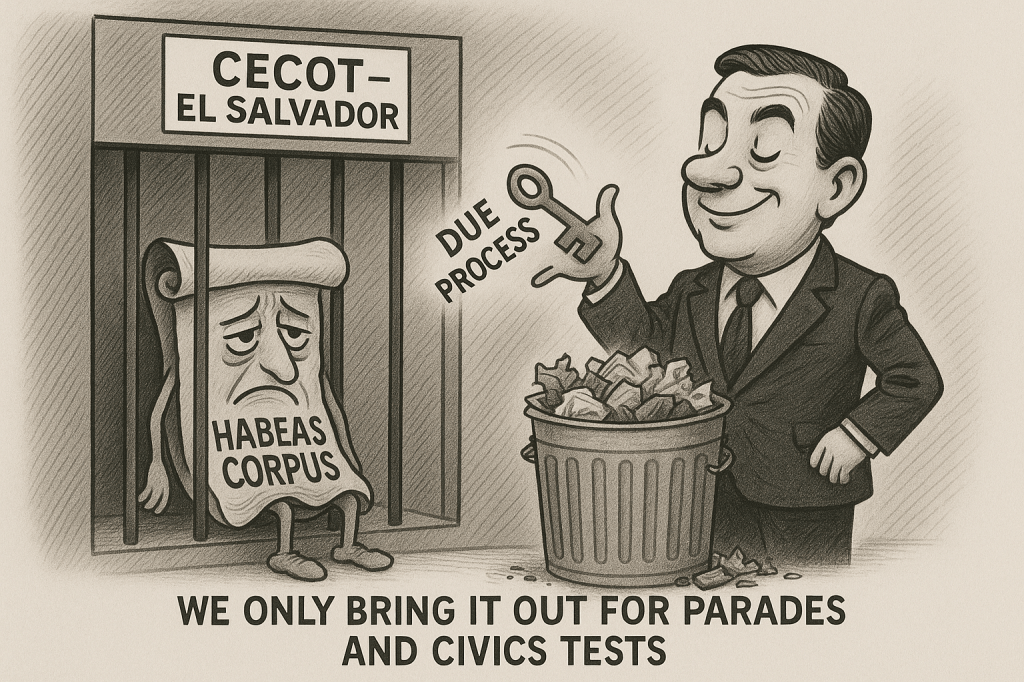
Give me liberty, or give me death!
Patrick Henry, Speech to the Second Virginia Convention (1775)
They never wanted you to have it. Not the barons, not the kings, not the emperors, the warlords, the presidents, the prime ministers, or the twitchy-eyed lawmen with mirrored sunglasses and a badge that doubles as a license to cage. Habeas corpus—you have the body—is the legal equivalent of slamming the brakes on the state’s black-ops kidnapping van and demanding: “Show me the son of a bitch you say you’re holding. Now.”
This one greasy Latin phrase, first scrawled into history in the swampy banks of Runnymede in 1215, is not polite. It is not diplomatic. It does not beg for freedom—it demands it. It is the unruly older brother of every civil liberty we pretend to love, the ancient legal boot that kicks in the doors of power and says: “Bring the prisoner to court and prove you’re not a goddamn tyrant.”
1215: The King Eats Dirt
Picture this: King John, red-faced, bloated, and wildly unpopular, has pushed his feudal cronies too far. He’s taxing the nobles like a drunken pimp, losing wars like a medieval Washington General, and finally the barons drag him into the weeds to sign the Magna Carta. It’s not a romantic moment—it’s political extortion with swords. But buried in that parchment—somewhere between clauses on fish weirs and inheritance fees—lies a proto-writ of habeas corpus.
The idea: the Crown cannot toss you into a dungeon just because it’s Tuesday and you looked at a royal the wrong way. The state must justify its grip on your flesh. This is not mercy. It is resistance codified.
No free man shall be seized or imprisoned, except by the lawful judgment of his equals or by the law of the land.
Magna Carta, Clause 39 (1215)
The Empire Strikes Back
Over the next few centuries, the British legal machine tries to smother the idea in red tape. Parliament passes the Habeas Corpus Act in 1679, reinforcing the rule that prisoners must be charged or released. But the ruling class has always treated habeas corpus like a backup fire extinguisher—something to brag about at parties but ignore when the house actually catches fire.
Every empire needs loopholes. The Brits had them in India, Ireland, and the colonies. The writ was real—until it wasn’t.
The writ of habeas corpus is the most celebrated writ in the English law. It is the great and efficacious writ, in all manner of illegal confinement.
William Blackstone, Commentaries on the Laws of England (1765)
1776: Revolution by Paperwork
The American colonists weren’t just mad about tea. They were tired of being snatched off the street and locked up without trial. The Founding Fathers may have been powdered-wig aristocrats with questionable dental hygiene, but they knew the value of habeas corpus. It made it into Article I, Section 9 of the U.S. Constitution, right between the lines about taxation and titles of nobility: “The Privilege of the Writ of Habeas Corpus shall not be suspended, unless when in Cases of Rebellion or Invasion the public Safety may require it.”
Translation: Don’t suspend this right unless the wolves are already through the gates and gnawing on the furniture.
The habeas corpus is a great constitutional privilege, not to be suspended or denied except in extreme cases.
Chief Justice Salmon P. Chase, Ex parte Milligan (1866)
Lincoln’s Dirty Hands
And then came Lincoln. Yes, Honest Abe. Patron saint of freedom and beard oils. He suspended habeas corpus during the Civil War—arguably to save the Union, but in doing so, he opened the door to the terrifying possibility that even good men with noble causes might trample rights under the boots of necessity.
Let history show: the first American president to crush civil liberties was also the one on the penny.
Let the president stand upon the Constitution, not trample it under foot!
Editorial in the Chicago Times, 1863
(After President Abraham Lincoln ordered the suppression of anti-war newspapers.)
Post-9/11: Gitmo, Black Sites, and the Disappeared
Fast-forward to the 21st century, where the war isn’t against Redcoats or Johnny Reb but terror. Habeas corpus was damn near lynched in a back alley after 9/11. The Bush administration—drunk on fear, power, and Rumsfeldian lunacy—built a legal Frankenstein in Guantanamo Bay. American citizens? Foreign nationals? The answer was the same: no trial, no charges, no hope. The Constitution was reduced to a bumper sticker, and habeas was buried under a pyramid of classified memos.
Even now, the ghost of habeas corpus wanders detention centers, immigrant jails, and airport holding cells—asking in vain for due process while the system clicks its rubber gloves.
The Founders regarded the writ of habeas corpus as a vital instrument for the protection of individual liberty.
Justice Sandra Day O’Connor, Hamdi v. Rumsfeld (2004)
The Final Safeguard
Here’s the bloodshot truth: without habeas corpus, the government can disappear you. Full stop. They can call you a threat, a terrorist, an enemy of the people. No lawyer. No charges. No sunlight. Just shackles and a sterile room and a number stapled to your identity.
This is not paranoia. This is precedent.
So when some jackass with a law degree on cable news tells you we need to “rethink due process” or “streamline the justice system,” what he means is kill habeas corpus quietly and replace it with a menu of pre-approved punishments. He wants to burn the bridge between accusation and defense—and let you drown in the gap.
In times of crisis, some rights must give way to the necessities of the moment.
Harvard Law Professor and Jeffery Epstein Buddy Alan Dershowitz, Post-9/11
(Yes, he also later offered legal theories defending preemptive torture and surveillance without warrants.)
We’re All One Writ Away From the Abyss
Every free society is one step away from tyranny. Habeas corpus is that step. It’s not perfect. It’s not sexy. But it is the last line of defense between you and the dark engine of state violence. Strip it away, and what’s left isn’t a nation. It’s a cell block with a flag on the roof.
So let me say this plainly: if you care about freedom, fight for the writ. Keep it alive. Keep it loud. Because once it’s gone, there’s no asking questions from the bottom of a black site. There’s only silence.
And silence, my friend, is the favorite sound of every bastard who ever wanted to make you disappear.
The President must have flexibility in wartime to detain threats without interference from civilian courts.
Because judicial oversight is just so inconvenient when you’re trying to run a global kidnapping program.
 TheSignal.Report
Leave a comment