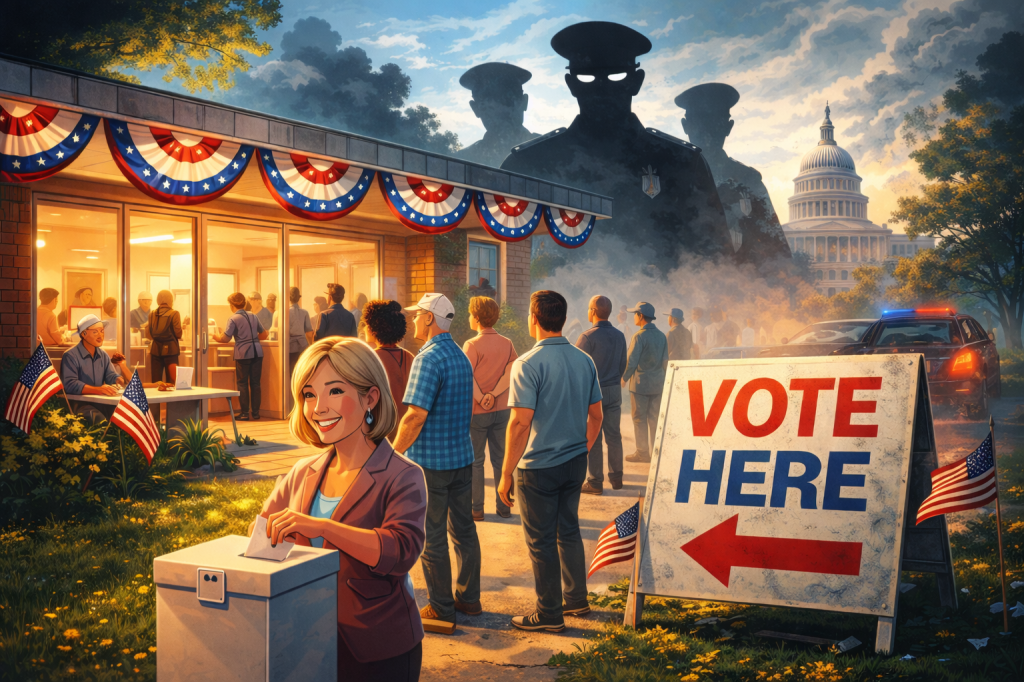
Coded language, intimidation, and the quiet push for centralized control—and the one place ordinary citizens can still break the spell.
There are moments when the air changes. You can feel it before you can name it. The words coming out of powerful mouths start to sound less like persuasion and more like instruction. Less like opinion and more like permission.
We are in one of those moments now.
When Donald Trump talks about nationalizing voting infrastructure, he is not proposing reform. He is rehearsing control. When he frames state-run elections as a problem to be solved by federal authority, he is not defending democracy. He is testing whether the public will tolerate the idea of overriding it.
This is not policy debate. This is pre-authoritarian signaling. Anyone trained in intelligence work, counterintelligence, or threat analysis hears it immediately. The rest of the country is being asked to learn the language fast, because waiting for explicit proof is how democracies lose their last chance to say no.
How Intelligence Professionals Read Coded Language
People unfamiliar with intelligence work expect intent to announce itself clearly, like a bad movie villain explaining the plot. That is not how it happens. Intent hides. It wears euphemisms. It repeats itself just often enough to feel normal.
Coded language is not about secret words. It is about patterned ambiguity. Language that means one thing to the public, another to loyalists, and something operational to those positioned to act. This is how movements probe boundaries without triggering immediate resistance.
Intelligence professionals do not ask, “Did he explicitly say he would do this?”
They ask, “Who is being signaled, and what behavior does this language authorize?”
When Trump talks about “securing” elections by centralizing control, the phrase is not the payload. The payload is what it normalizes. It reframes elections as a federal problem rather than a constitutional function protected by decentralization. Once that frame sticks, the mechanics become negotiable. Emergency powers appear. Exceptions are carved out. Oversight is recast as obstruction.
This is called pre-operational shaping. It is the rhetorical conditioning that makes extraordinary action feel inevitable and even responsible. By the time the action arrives, the argument has already been won in the language layer.
Another critical concept is plausible deniability. Not as a legal shield, but as a psychological weapon. If followers harass officials or demand extra-legal action, the leader disavows responsibility. If institutions push back, he claims persecution and doubles down. Either way, the pressure escalates.
This is not accidental drift. It is operational ambiguity, a tactic borrowed from information warfare. The goal is activation without accountability.
Democracies are uniquely vulnerable to this because they assume good faith. They assume language is meant to persuade, not to probe for weakness. Authoritarian movements exploit that assumption relentlessly. Every time institutions wait for explicit intent, the window narrows. By the time intent is undeniable, the mechanisms to stop it are already compromised.
Coded language is not meant for everyone. It is meant for bureaucrats who want cover, extremists who want permission, loyalists who want reassurance, and institutions that can be pressured into compliance.
When voters are reframed as threats, management replaces consent. Intimidation becomes policy with a smile.
The Part They Hope You Don’t Know: The Constitution Already Settled This
Here’s the detail Trump never mentions when he starts talking about “taking control” of elections, and it’s not obscure or debatable or buried in legal dust.
The Constitution already made this decision.
Election administration in the United States is not a federal gift. It is not a privilege granted by Washington. It is a state power, assigned deliberately and explicitly because the people who wrote the Constitution had seen what happens when central governments get their hands on ballots.
Article I, Section 4 hands the mechanics of federal elections to the states. The times. The places. The manner. That is not poetic language. It is operational. It means states run elections first, by default, as a matter of constitutional design.
And standing behind that clause like a loaded revolver on the table is the Tenth Amendment, which makes the point even clearer. Any power not explicitly handed to the federal government belongs to the states or the people. Elections were never surrendered. They were intentionally dispersed.
This is not a loophole. It is a safeguard.
That is why elections in this country are administered state officials and locally. By county registrars. By election workers who live in the communities they serve and answer to voters, not to a single national authority. Decentralization is not inefficiency. It is defense.
When someone talks about nationalizing elections, they are not proposing reform. They are proposing to override a constitutional firewall that exists for one reason only: to prevent exactly that kind of takeover.
This is why federal control would be catastrophic. It collapses dozens of independent systems into one chain of command. It replaces redundancy with obedience. It turns elections from a civic process into an administrative asset.
And once that happens, democracy no longer needs to be stolen.
It just needs to be managed.
The Pattern Is Always the Same, and the Excuses Are Always Familiar
Democracy never collapses in a single afternoon. That would be too obvious. What collapses first is legitimacy, softened over time until control feels like housekeeping instead of theft.
The pattern is dull in its predictability.
It begins with doubt. Not proof. Just doubt. Elections are described as uncertain. Questionable. In need of review. Uncertainty sounds reasonable. It invites supervision. It creates space for authority to step in and “help.”
Then come the audits. Always audits.
Audits stacked on audits, each framed as the final search for truth and none allowed to be final. When nothing is found, the absence becomes suspicious. The system is accused of hiding too well. Reality is put on trial and found evasive.
Next comes the slow turning of the crowd toward the administrators. The people who actually run elections. Career civil servants. County clerks. Registrars. The boring professionals who keep the lights on and the ballots moving.
They are recast as obstacles. Their experience becomes arrogance. Their refusal to falsify outcomes becomes defiance. Their silence becomes guilt.
This is the hinge point. Once local officials are framed as untrustworthy, central control stops sounding radical. It starts sounding responsible.
Someone has to step in. Someone has to restore confidence. Someone has to take charge.
Then comes the word that kills republics quietly. Temporary.
Temporary oversight. Temporary intervention. Temporary suspension of normal processes. Democracy is not abolished. It is sedated.
What makes this work is that every step can be defended in isolation. Each action is wrapped in procedure and legal language. By the time the public understands what has happened, the argument is no longer about whether control should exist. It is only about who holds it.
Centralized election control does not exist to prevent fraud. It exists to remove resistance points. Local systems are slow and irritating because they answer to too many people. They produce records, witnesses, and contradictions.
Central authority solves that problem neatly.
Once elections are managed from the top, dissent becomes a technical issue. Votes become data. Disagreement becomes instability. Protest becomes interference.
None of this requires tearing up the Constitution. Authoritarian systems prefer legality. They move inside the language of law while draining it of meaning.
This is why Trump’s language matters. Not because it is shocking, but because it is preparatory. It conditions people to see decentralized elections as failure and centralized control as cure.
Anyone waiting for a single unmistakable authoritarian moment is already too late. The takeover does not arrive with sirens. It arrives with press conferences and calm men explaining that this is unfortunate, but necessary.
Intimidation Is the Policy: How Attrition Replaces the Coup
By the time people are arguing about whether intimidation is happening, it has already worked.
Modern power does not need mass arrests. It prefers attrition. Pressure applied slowly and personally until the job becomes unbearable and the witnesses disappear on their own.
Election officials are targeted not because they are powerful, but because they are exposed. They sit at the intersection of law, procedure, and public trust. They sign documents that reality exists.
The tactics are crude and effective.
Threats by phone and email. Vague promises of future trials. Doxxing of home addresses and families under the lie of “public accountability.” Weaponized public records requests designed to bury offices in compliance work. Baseless criminal referrals that never need to succeed. Legal defense is expensive. Stress is corrosive.
Sometimes the intimidation goes physical. Protesters outside offices. Cars parked too long near homes. Cameras pointed at doors. Weapons displayed “legally,” because legality is the shield that allows terror to masquerade as speech.
No single act looks like a coup. Each incident is dismissed as isolated. Together they form a system designed to thin the herd.
This is not about changing votes. It is about changing who is willing to administer them.
Every resignation is a victory. Every early retirement opens a vacancy for someone more obedient or less qualified. Democracy bleeds out quietly, one LinkedIn update at a time.
Silence is not neutrality. Silence is oxygen.
When election officials are attacked and the public shrugs, the message is received. You are alone. You are expendable.
Authoritarian movements understand something many liberals refuse to accept. You do not have to seize institutions if you can empty them.
What Citizens Must Watch For Now
If you want to stop election meddling before it becomes irreversible, watch for these signals.
First, vague expansions of “security” language with no defined threat. Ambiguity justifies authority.
Second, routine election administration reframed as suspicious. When normal process is treated as wrongdoing, the goal is delegitimization.
Third, pressure on state and local offices to surrender authority “voluntarily.” Federal task forces and joint oversight that sound cooperative while stripping autonomy.
Fourth, attacks shifting from systems to people. Qualifications replaced by loyalty tests.
Fifth, enforcement agencies with no election mandate seeking voter data, including agencies like U.S. Immigration and Customs Enforcement. Jurisdictional creep never flows toward democracy.
Sixth, voter participation itself framed as a problem. High turnout described as suspicious. Early voting portrayed as risky.
Finally, the language of inevitability. The public has lost confidence. Extraordinary measures are unavoidable. These are not observations. They are excuses.
Waiting for proof is a mistake. Proof arrives too late.
Protect the Frontline
Protect local election officials. They are the frontline. Show up to meetings. Defend them publicly. Intimidation thrives in silence.
That means your county Registrar of Voters, your County Clerk, your local elections office, and your Secretary of State. Elections in this country are administered locally by career public servants who secure ballots, manage vote centers, and certify results while absorbing abuse they did not earn.
These are not partisan actors. They are civil infrastructure. Protect these workers. They work hard to protect your voice. Once they are driven out or silenced, the machinery of democracy collapses quietly behind them.
From Defense to Participation: Put Your Body in the System
Defense alone is not enough.
If you want to stop an authoritarian takeover, you cannot remain a spectator. You have to enter the system they are trying to break.
Apply to be an election worker or poll worker.
These are short-term, paid public service jobs that destroy myths fast. You see the chain of custody. You see the redundancy. You see observers watching every move. Fraud narratives do not survive proximity to procedure.
In Los Angeles County, more than 10,000 election workers are hired for each election. That scale is a safeguard.
Los Angeles County contains 88 cities, each with its own elected city council. The Registrar administers city elections, congressional races, gubernatorial elections, state legislators, county judges, school boards, water and utility district boards, and special elections.
This is what real democracy looks like. Local. Fragmented. Redundant. Resistant to capture.
Federal control would be a disaster because it collapses thousands of accountability points into a single lever of power.
Working an election gives you a civic education no cable panel ever will. You also get paid. Not as charity. As recognition that this is labor.
Every election worker added is one less vacancy for a loyalist. One more witness. One more human firewall.
If you want to fight back, do not just protest the system.
Staff it.
The Final Warning, and the One Thing That Works
Language always comes first.
Before the levers move, the words soften the ground. Security. Order. Control. By the time people realize those words were never neutral, the machinery is already humming.
This is the moment.
Do not wait for a hero. Do not wait for permission.
Become an election worker. Sign up now. Contact your local elections official. Call them or visit their website. In many places, the process is simple and may even be entirely online. They will walk you through it.
Democracy survives not on belief, but on people who show up, follow rules, document everything, and refuse to flinch when power starts speaking in code.
The people who want to break democracy are counting on you to stay home.
Do not oblige them.
 TheSignal.Report
Leave a comment