I am haunted by the feeling that by 1970, unless we are successful, there may be ten nuclear powers instead of four, and by 1975 fifteen or twenty.
— John F. Kennedy, March 21, 1963
The Desert Knows How to Keep Secrets
The desert has a way of hiding things.
The old Las Vegas mob families understood that long before the Pentagon ever started worrying about uranium. Out past the neon glow of the Strip, beyond the blackjack tables and cheap motel lights, the desert stretches out like a giant evidence locker with no filing system and no witnesses.
You could bury almost anything out there.
A crooked casino accountant who skimmed too much.
A gambler who asked the wrong question.
A Cadillac full of problems that needed to disappear before sunrise.
The sand swallows it all. Wind smooths the surface. The sun bleaches away the memory. By morning the desert looks exactly the way it did the day before.
The mob bosses knew it.
The military knew it.
And somewhere deep in the Negev Desert, the nuclear age learned the same lesson.
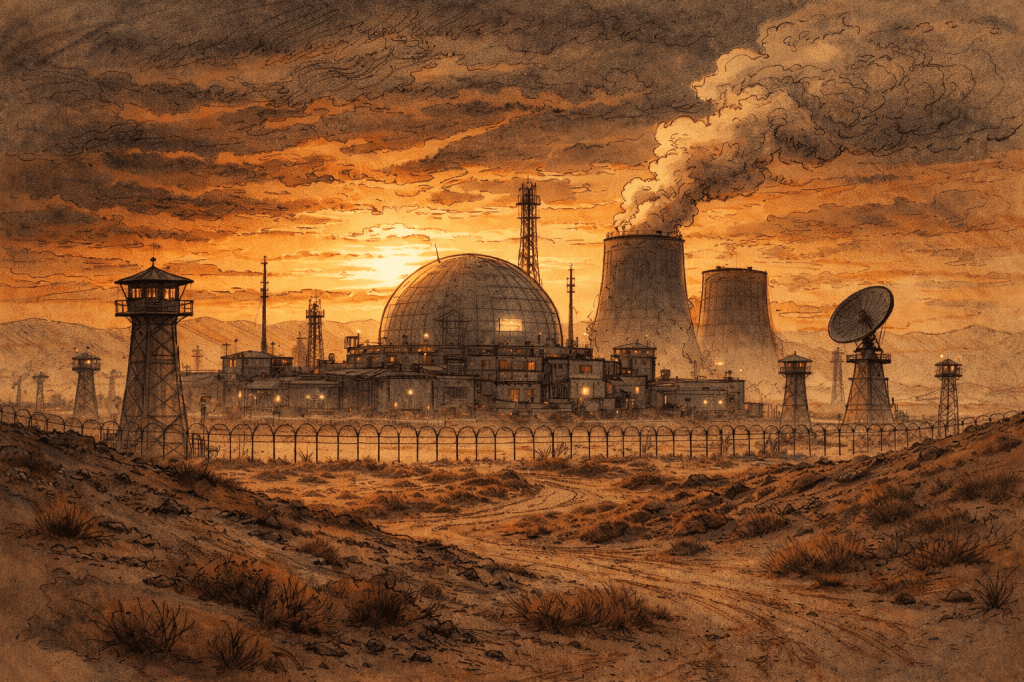
Because buried beneath layers of concrete, fencing, and diplomatic silence sits one of the most consequential machines ever built.
A nuclear reactor called Dimona.
Israel officially describes the facility as a research center devoted to peaceful atomic energy. That explanation has been repeated for decades and has acquired the tone of diplomatic folklore.
But intelligence agencies have never been entirely comfortable with that story.
For years analysts have suspected that Dimona may be the birthplace of Israel’s nuclear weapons capability. Israel maintains a policy of nuclear ambiguity and refuses to confirm or deny whether such weapons exist.
Most American presidents eventually learned to live with that arrangement.
Except one.
In the early 1960s John Fitzgerald Kennedy looked at the reactor in the desert and decided it was a problem that could not be ignored.
The Cold War’s Most Dangerous Side Project
The early 1960s were not a relaxing time to think about nuclear weapons.
The United States and the Soviet Union were pointing thousands of warheads at each other across the planet. The Cuban Missile Crisis in 1962 had nearly turned the Cold War into a radioactive obituary for civilization.
Kennedy came out of that confrontation convinced of one thing.
The world could not survive unlimited nuclear proliferation.
He warned that if nuclear weapons spread unchecked the planet could eventually face fifteen or twenty nuclear armed states. Every new arsenal would increase the odds that somebody somewhere would make a fatal mistake.
Then American intelligence agencies began noticing something unusual.
Israel was constructing a nuclear reactor complex in the Negev Desert.
The facility had been built largely with French assistance after the Suez Crisis of 1956, when France and Israel developed close military cooperation. Officially the reactor was intended for research and energy development.
But analysts studying the design saw something else.
The reactor appeared capable of producing plutonium, the essential material used to build nuclear weapons.
For Kennedy that possibility was not an academic concern.
If Israel obtained nuclear weapons, its regional rivals might attempt to do the same.
The Middle East could become the next theater of nuclear brinkmanship.
When the President Started Asking Dangerous Questions
Washington has always been a city that survives on the fine art of not noticing things.
If a problem becomes politically inconvenient, the capital has developed an elegant ritual for handling it. Committees are formed. Reports are written. Panels of experts gather in conference rooms to produce long documents recommending patience, dialogue, and more studies.
The cocktails are excellent.
The deniability is even better.
Kennedy disrupted that rhythm.
When intelligence analysts showed him photographs of the Dimona complex rising out of the desert, he did not nod politely and move on.
He asked a simple question.
Why does a small country surrounded by enemies need a reactor capable of producing plutonium?
By 1963 American intelligence agencies were increasingly concerned about Dimona. Historians examining declassified records later confirmed that the reactor had the technical capability to produce plutonium suitable for nuclear weapons.
Kennedy decided to push back.
In May and June of 1963 he sent a series of letters to Israeli Prime Minister David Ben-Gurion demanding that Israel allow regular inspections of the Dimona facility.
The language was unusually blunt for diplomatic correspondence.
Kennedy warned that American support for Israel could be seriously jeopardized if credible inspections were not allowed.
In diplomatic language that sentence lands like a brick through a window.
Ben-Gurion understood the message.
Israel agreed to allow American scientists to visit the facility, but the tours were tightly controlled. Inspectors were escorted through selected parts of the complex while other sections remained off limits.
American analysts suspected the visits did not reveal the full picture.
Kennedy suspected it too.
The Birth of Nuclear Ambiguity
Out of this confrontation emerged one of the strangest policies in modern geopolitics.
Israel would never publicly confirm possessing nuclear weapons.
But it would never deny them either.
This doctrine became known as nuclear ambiguity.
The policy allowed Israel to maintain deterrence without formally declaring itself a nuclear power. It also spared allies like the United States from having to publicly confront the issue.
By the mid-1960s intelligence analysts believed Israel may have achieved a nuclear capability.
Officially nothing had changed.
The bomb remained unspoken.
The reactor continued operating.
And the diplomatic fiction held.
November 1963
On November 22, 1963 John F. Kennedy was assassinated in Dallas.
There is no credible historical evidence linking Kennedy’s death to Israel’s nuclear program.
But his death changed the trajectory of American policy.
His successor Lyndon Johnson did not pursue the Dimona inspections with the same urgency. Over time an informal understanding emerged between Washington and Israel.
Israel would not publicly acknowledge nuclear weapons.
Washington would not force the issue.
The reactor in the desert continued humming quietly.
The Quiet Arsenal
Israel has never officially confirmed possessing nuclear weapons. However many defense analysts believe the country may possess dozens of warheads if the suspected program exists.
The Stockholm International Peace Research Institute and other nuclear researchers estimate that the number could be around ninety.
Officially the weapons remain unconfirmed.
Unofficially governments around the world plan their strategies as if they exist.
For decades that uneasy arrangement helped maintain stability in a volatile region.
But nuclear deterrence has a strange side effect.
It inspires imitation.
The New Nuclear Nightmare
Nuclear weapons rarely explode.
Most of the time they simply exist.
Locked inside bunkers. Hidden inside submarines. Sitting quietly in desert facilities where the wind sounds like an argument with the sun.
Their real power is psychological.
One bomb convinces a rival to build two.
Two bombs convince a neighbor to build five.
Soon everyone is standing in the same room holding gasoline and matches, insisting they are the responsible ones.
Iran continues expanding its uranium enrichment capabilities. The International Atomic Energy Agency has warned that monitoring gaps make it increasingly difficult to verify the full scope of Iran’s program.
The fear in Western capitals is not only that Iran might eventually build a nuclear weapon.
The deeper fear is what happens after that.
Because once the nuclear club expands it rarely shrinks.
The Desert Arms Race
Imagine waking up tomorrow morning to the news that Iran possesses a nuclear weapon.
Maybe they built it.
Maybe they bought it.
Maybe it arrived quietly through a geopolitical back channel that will never appear in a public report.
North Korea already has nuclear weapons and has exported missile technology before. China is expanding its strategic nuclear forces rapidly.
According to SIPRI the world currently possesses roughly twelve thousand nuclear warheads.
Nine countries already hold nuclear arsenals.
That number has a habit of growing.
If Iran joined the club the reaction across the Middle East would be immediate.
Saudi Arabia would demand its own deterrent.
Turkey would reconsider its strategic posture.
Egypt would face the same decision every nation eventually confronts when nuclear weapons enter the neighborhood.
Build the bomb.
Or trust someone else to protect you.
History suggests trust rarely wins.
The Old Question Returns
Kennedy understood the danger early.
After the Cuban Missile Crisis he warned that nuclear proliferation could eventually produce twenty nuclear armed nations.
He looked at a reactor rising from the Negev Desert and saw the first crack in that future.
Most presidents who followed him decided the problem was too complicated to confront.
So the silence held.
The reactor kept humming.
And the world quietly adapted to a bomb that may or may not exist.
Meanwhile the global nuclear club kept growing.
Nine countries now possess nuclear weapons.
Roughly twelve thousand warheads still sit on this planet.
Enough firepower to turn human civilization into a geological layer.
And deserts are still very good at hiding things.
The mob knew it in Nevada.
Strategists know it in the Middle East.
Somewhere beneath the sun-blasted sand of the Negev Desert sits a reactor that has shaped global politics for more than sixty years.
Quiet.
Patient.
And humming like a secret everyone agreed not to mention out loud.
The desert keeps the secret.
History eventually digs it up.
Sources
John F. Kennedy Presidential Library – March 21, 1963 Press Conference (Kennedy warning about nuclear proliferation)
https://www.jfklibrary.org/asset-viewer/archives/JFKPOF-034-015
National Security Archive – Declassified correspondence between President Kennedy and Israeli leadership regarding inspections of the Dimona reactor
https://nsarchive.gwu.edu/briefing-book/nuclear-vault/2016-03-22/kennedy-ben-gurion-dimona
Avner Cohen, Israel and the Bomb, Columbia University Press
New York Times historical coverage of U.S. inspections of the Dimona reactor
https://www.nytimes.com/1963/07/21/archives/us-inspects-israel-reactor.html
CIA declassified intelligence assessments related to Israel’s nuclear program (National Security Archive collection)
https://nsarchive.gwu.edu/project/israeli-nuclear-history
Stockholm International Peace Research Institute (SIPRI) – World Nuclear Forces and global nuclear arsenal estimates
Federation of American Scientists – Global nuclear weapons overview and analysis
Nuclear Threat Initiative – Israel nuclear program profile and Dimona background
https://www.nti.org/countries/israel/
International Atomic Energy Agency – Monitoring and reporting on Iran’s nuclear program
Reporting on North Korea signaling possible missile support to Iran
 TheSignal.Report
Leave a comment