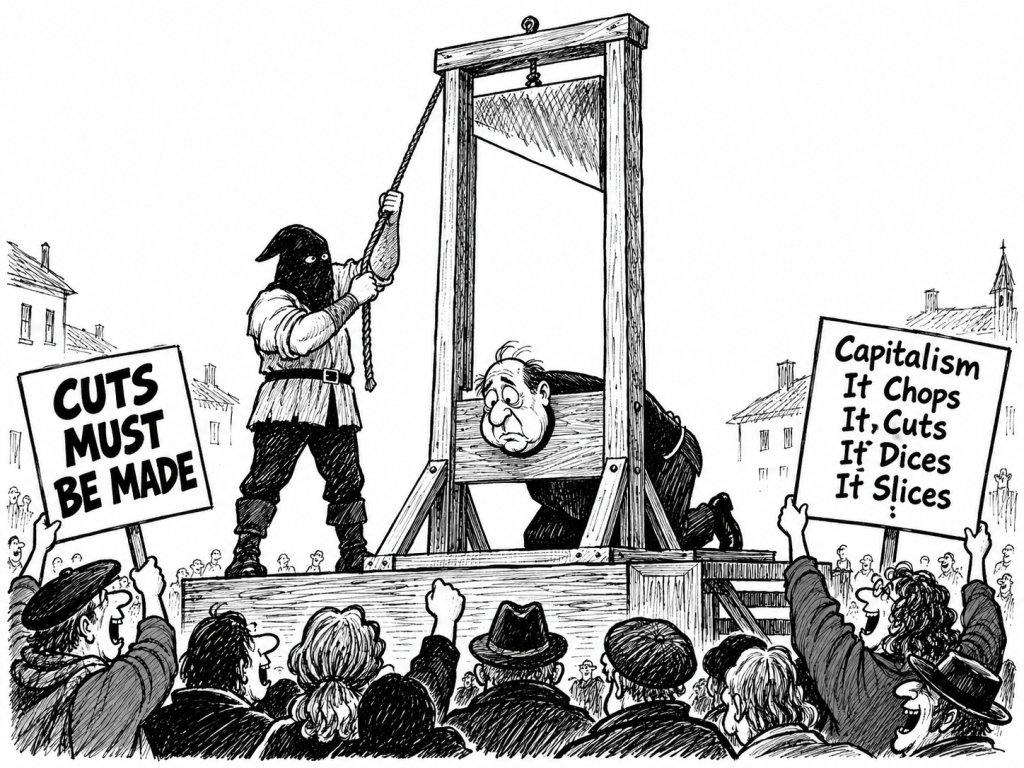
There are certain objects a man should not build in his garage during a period of national instability.
A submarine.
A flamethrower.
A fully functioning guillotine.
This is particularly true if you own power tools, drink bourbon before sunset, and have developed the unhealthy habit of reading history while the television mutters political news from the next room like a dying priest.
But there I was on a Friday afternoon with twelve feet of lumber, six carriage bolts, a borrowed circular saw and a steel blade heavy enough to make the neighbors wonder whether they should call the police or simply move.
Relax.
It is for firewood.
That is what I told everyone.
Firewood.
The French, contrary to popular belief, did not invent the basic idea. The English had been fooling around with head-removal machinery centuries earlier, because apparently mankind discovered bureaucracy and mechanized execution at roughly the same stage of development.
But the French perfected the branding.
They gave it elegance.
Efficiency.
Republican flair.
The guillotine became less a machine than an argument with gravity.
And gravity, unlike politicians, has never needed a press secretary.
I measured the uprights.
Eight feet.
Perfect.
The blade would travel between them.
Simple physics.
Simple machinery.
Simple ideas are dangerous things.
This is why governments prefer committees.
The France that eventually became acquainted with the National Razor was a nation of extraordinary wealth occupied by an extraordinary number of people who could not afford bread.
This was considered perfectly reasonable by the people who owned everything.
The ruling class had titles, estates, offices and magnificent furniture. What they frequently did not have was any obvious qualification for the positions they occupied.
Jobs could be purchased.
Appointments could be traded.
Friends were installed.
Relatives were promoted.
Loyalty became a credential.
Competence became suspicious.
And somewhere inside those gilded rooms there was always a man explaining that this was actually meritocracy.
I drilled another hole.
The television was talking.
Some official somewhere was explaining that everything was going extremely well.
This is one of the oldest noises in government.
Everything is going extremely well.
The peasants may be eating wallpaper paste and boiling shoes for soup, but according to the Ministry of Tremendous Prosperity, the nation has never been stronger.
France had debt.
France had wars.
France had taxes that seemed to possess the remarkable ability to locate poor people while becoming mysteriously confused around great wealth.
France had officials who treated government as a family business and the law as a decorative suggestion.
None of this meant the system was failing.
Good God, no.
The system was magnificent.
Anyone saying otherwise was probably dangerous.
Or disloyal.
Or radical.
Possibly foreign.
This is another wonderful feature of collapsing political systems: criticism eventually becomes more offensive than the thing being criticized.
The blade assembly required two steel brackets and a great deal of swearing.
By now the thing stood upright in the garage like some terrible piece of IKEA furniture designed by Robespierre.
I stepped back.
Beautiful.
Horrifying.
Functional.
Firewood.
Remember that.
The television continued whispering from inside the house.
Enemies.
Investigations.
Traitors.
Corruption.
Justice.
Retribution.
Victory.
Words flying around like bats in an attic.
History becomes uncomfortable when the vocabulary starts repeating itself.
The people who lived through the final years of the French monarchy did not wake each morning thinking:
Ah yes, another fascinating chapter in the collapse of the ancien régime.
They went to work.
They complained about prices.
They worried about rent.
They argued about politicians.
They heard rumors.
They watched institutions bend a little.
Then bend a little more.
And somewhere, almost certainly, some exhausted bastard said:
They would never let it go that far.
History is full of people saying this immediately before it goes that far.
This does not mean history repeats itself.
That would be ridiculous.
History is far too sophisticated for that.
History merely develops a drinking problem and begins calling you at three in the morning.
“Remember France?” it whispers.
No.
Go to sleep.
“Remember the debt?”
Stop calling me.
“Remember the political patronage?”
Wrong number.
“Remember the mobs?”
CLICK.
I attached the blade.
There are moments in any construction project when the object stops being lumber and hardware and suddenly becomes the thing you intended to build.
This was one of those moments.
It stood there.
Eight feet tall.
Two hundred pounds.
A monument to Enlightenment-era problem solving.
And naturally I began wondering about justice.
Not vengeance.
Justice.
The distinction is enormously important and historically difficult to maintain.
The French Revolution began with splendid nouns.
Liberty.
Equality.
Fraternity.
Most political disasters begin with excellent nouns.
The trouble usually starts with the verbs.
Accuse.
Purge.
Punish.
Execute.
Soon everyone discovers that a machine designed for your enemies has an unfortunate tendency to remain operational after your enemies are gone.
That was the terrible genius of the guillotine.
It did not care about ideology.
Royalist.
Revolutionary.
Moderate.
Radical.
Yesterday’s patriot.
Tomorrow’s traitor.
Gravity accepts everyone.
Which is probably the most useful lesson in the whole miserable story.
Institutions built to destroy your enemies rarely ask permission before changing owners.
I dragged a watermelon onto the block.
The television was still talking about America.
A golden age, apparently.
Everything magnificent.
Everything historic.
Everyone corrupt except us.
Everyone lying except us.
Everyone dangerous except us.
Nothing to worry about.
Nothing familiar here.
Certainly nothing French.
I pulled the release.
WHAM.
The watermelon exploded.
Red pulp sprayed across the concrete.
Jesus Christ.
I stared at it.
Then at the machine.
Then toward the house, where another important man was explaining why the country had never been safer, richer, stronger, freer, happier or more spectacular.
I unplugged the television.
Silence.
Much better.
History does not repeat itself.
America is not France.
Politicians are honorable.
Institutions are permanent.
The powerful respect limits.
The law applies equally.
The public cannot be manipulated forever.
And any similarity between the final decades of the French monarchy and anything happening in the United States today is purely coincidental.
Obviously.
Anyway.
Tomorrow I am testing the guillotine on a cinder block.
For educational purposes.
And firewood.
Mostly firewood.
 TheSignal.Report
Leave a comment