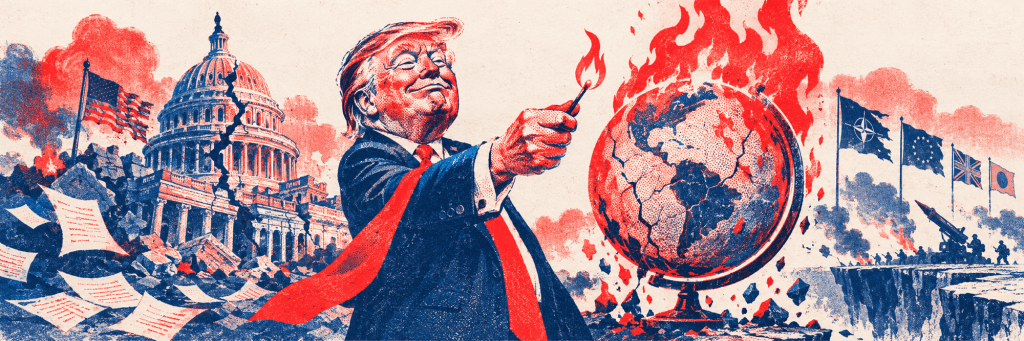
Donald Trump’s foreign-policy spectacle is testing America’s alliances, its institutions and the patience of the people left paying for it.
There is a certain kind of man who mistakes a quiet room for a room in agreement. He talks. Everyone else stops. He walks out convinced he’s the smartest bastard in the building. In ordinary life, you can avoid him at Thanksgiving. In Washington, he gets a motorcade and the nuclear codes.
America has spent the better part of 250 years trying to keep that particular problem under control. We wrote a Constitution, split up the powers, invented oversight, built a civil service and held elections so that no one man could decide the entire country belonged to him. Then we developed television, discovered the intoxicating pleasures of public humiliation and elected the host of The Apprentice president. Twice.
Now the country’s foreign policy seems to operate on the emotional logic of a reunion episode. Allies are expected to profess their gratitude. Rivals get threats. Negotiations become performances. Every setback requires a villain, preferably one who can be blamed before the commercial break.
The joke has traveled badly. Denmark isn’t laughing. Canada is looking for other customers. Europe is making contingency plans. Iran is a war, not a soundstage, and Moscow and Beijing are watching the whole mess with professional interest.
Trump didn’t create the nation’s divisions or its addiction to money and spectacle. That work took decades and a bipartisan cast. But he has given those weaknesses extraordinary leverage over actual decisions. The damage isn’t confined to the reputation of one president. It touches the machinery that keeps Americans safe, the relationships that make us powerful and the prospects of generations who will be stuck paying for decisions made by people who won’t be around to explain themselves.
Fire the watchdogs, then demand our trust
Government is at its best when nobody notices it. The bridge holds. The water is clean. The pharmacy is inspected. The ballot gets counted. No one announces that the chemical plant didn’t explode today, and no one runs a victory lap when a federal inspector finds a dangerous defect before somebody dies.
That is what makes competent administration so vulnerable to political showmen. Preventing a catastrophe doesn’t go viral. Firing the people who prevent it does.
During Trump’s second term, the administration pursued changes that would make certain federal employees easier to dismiss. Its supporters argue that elected officials need the power to hold a bureaucracy accountable. That’s a legitimate debate. It becomes considerably less reassuring when independent scrutiny is weakened at the same time. A Washington Post analysis reported that staffing at inspectors general offices fell 16.6 percent between January 2025 and early 2026, compared with 12 percent across the federal civilian workforce. [1]
Inspectors general investigate waste, misconduct and abuses of power. They are not ceremonial decorations for the lobby. Their job is to deliver unpleasant facts to people who may be furious to hear them. A government that steadily loses the capacity to hear bad news eventually acquires a magnificent talent for being surprised by disasters everybody else saw coming.
Then there’s the refusal to accept electoral defeat. Biden won the 2020 election, 306 electoral votes to 232. Trump won in 2024. Both results are facts; both were certified under the same constitutional machinery. [2] You cannot praise that machinery when it carries you into office and declare it fraudulent when it takes you out. That isn’t skepticism. It’s a demand for a personal exception to the rules.
We are supposed to be governed by laws, not the wounded feelings of whoever happens to be standing behind the presidential seal.
The tariff bill comes to American households
Go tell a single working mother of two children who is trying to replace a broken refrigerator that the price increase is an exciting display of American dominance. Bring a camera. I would enjoy hearing the response.
The Trump tariff pitch has always contained a magical little trick: announce a tax on imported goods, call it punishment for foreigners, then act astonished when Americans start paying more.
The Federal Reserve Bank of New York examined the 2025–26 tariffs and estimated that, after a year, about 26 percent of a tariff increase had passed through to consumer prices in the categories studied. Imported components also put pressure on prices for goods made here. [3] Tariffs have uses. Governments sometimes protect strategically important industries or negotiate over unfair trade practices. Fine. But a tax does not cease being a tax because the president delivers it with sufficient chest-thumping.
Imagine explaining to the owner of a small machine shop that the steel costs more because we’re teaching the rest of the world a lesson. Now explain why that owner has to charge more, postpone buying equipment or cut back on hiring. Go tell a single working mother of two children who is trying to replace a broken refrigerator that the price increase is an exciting display of American dominance. Bring a camera. I would enjoy hearing the response.
There’s a difference between rebuilding domestic industry and staging a fistfight with the supply chain. The former requires planning, investment, trained workers and years of patient work. The latter requires a microphone and the cheerful willingness to make someone else absorb the cost.
And costs compound. Money used to manage economic shocks can’t also go toward a home, an education or a new business. We can argue about which trade barriers are worthwhile. We cannot pretend the bill vanishes because it was announced at a rally.
Canada and Greenland are not Trump properties
I miss the days when the most awkward thing an American president could do to an ally was mispronounce the prime minister’s name.
Trump has repeatedly floated turning Canada into the fifty-first state. He also pushed for American control of Greenland, an autonomous territory within the Kingdom of Denmark, and in January 2026 threatened tariffs in the dispute before retreating from the prospect of force. [4] These are allies, not distressed properties in a portfolio waiting for a leveraged buyout.
Canadians are not required to find annexation funny. Neither are Greenlanders required to see themselves as an undeveloped opportunity for an American real-estate executive. They have governments, histories and the absurd expectation that their borders should mean something.
Canada’s government has been pursuing ways to diversify its trading relationships while negotiating with Washington. [5] European countries, meanwhile, have been reassessing their reliance on American weapons, technology and security promises. Reuters documented those pressures in September. [6] NATO hasn’t disappeared. But confidence is not an infinite commodity, and once a trusted partner begins speaking like a potential landlord, people start checking the lease.
There is a serious argument that allies should contribute more to their own defense. Make it. Demand numbers. Negotiate. But there is something spectacularly self-defeating about telling the people who help defend you that they might be next on your acquisition list.
The United States spent generations building relationships that extended its influence without having to threaten everyone in sight. Now some of those same friends have to calculate how much of their security can safely depend on the next thing the president says into a microphone. That isn’t a measure of renewed American strength. It’s an expensive new problem for our friends, and eventually for us.
Iran: a war needs an exit, not a victory announcement
On February 28, 2026, the United States and Israel struck Iran. The Trump administration pointed to Iran’s nuclear and missile programs and threats in the region. These concerns are serious. Iran’s government is no model of liberal democracy, and pretending its conduct is harmless would be idiotic. But recognizing a threat and deciding how to manage it are two different jobs. [7]
By September, the Congressional Research Service described retaliatory attacks, disruption to shipping through the Strait of Hormuz, unsuccessful efforts to end the conflict and renewed strikes. [7] The Pentagon estimated $47.1 billion in costs through October 16, according to figures obtained by the Associated Press. That estimate does not include damage to American bases from Iranian strikes. The Pentagon also reported 21 service members dead and 865 wounded, although not every death was directly caused by the fighting. [8]
Forty-seven billion dollars, hundreds of wounded Americans, and still no clean ending in sight. The invoice has acquired a human face.
The Strait of Hormuz is not obscure military trivia. It’s a narrow passage through which an enormous share of the world’s energy trade moves. Put a war around it and oil prices become everybody’s business, whether they supported the war or couldn’t locate Iran on a map.
The military can tell you what was destroyed. That is not the same as telling you what has been accomplished. If the objective is to reduce the danger of nuclear proliferation, what happens if Iran concludes that having a nuclear weapon is the only reliable way to avoid another attack? If the objective is regional stability, how much instability are we prepared to purchase to obtain it? Who has written the exit plan? Has anybody shown Congress the arithmetic?
Military historian Sarah C. M. Paine, speaking on The Diary of a CEO, distinguishes a battlefield success from a strategic one. The question isn’t simply whether you hit the target. It’s whether the decision leaves your country safer and more prosperous when the shooting stops. [9]
That seems like a reasonable test to impose before launching a war. And if the answer keeps changing, the people financing the operation are entitled to know why.
An enemy does not vanish because the president announces he won. Nor does an adversary surrender its interests because it was humiliated on television. Wars have an ugly capacity to outlive the reason given for starting them, particularly when the people responsible cannot bear to admit that something went wrong.
Russia and China are watching America’s alliances fray
One of the more infantile assumptions in American foreign policy is that nothing important happens unless Washington decides it should. Other countries, apparently, are just waiting backstage for their cues.
They aren’t.
Russia is watching American arguments over support for Ukraine. China is watching Europe diversify its security partnerships and Canada rethink its commercial dependence. Iran is watching the durability of American resolve and the limits of American force. It would be foolish to claim that every Trump decision hands these governments a victory. But it would be equally foolish to imagine that they aren’t studying the openings.
Remember the February 2025 Oval Office confrontation with Ukrainian President Volodymyr Zelenskyy? Trump and JD Vance argued with him in front of cameras; a proposed minerals agreement was left unsigned that day. [10] There were difficult questions to negotiate about war, money and future security. Instead, the world watched a meeting become a public dressing-down.
I’ve seen more diplomatic restraint at a parking-lot fender bender.
Putin invaded Ukraine. That fact doesn’t disappear because some Americans are tired of discussing it. Nor does support for Ukraine exempt anyone from asking how aid is spent or how a settlement might work. But if Washington treats its partners as contestants to be scolded for ratings, it shouldn’t be shocked when they start designing a future with fewer American dependencies.
Real power includes the ability to keep a promise. Once that becomes uncertain, your adversaries don’t have to defeat you outright. They can wait for you to make your friends less certain of you.
Congress is supposed to challenge the president
Here’s a suggestion for Congress, especially its Republican members: read Article I. It’s short. You can probably finish it between donor calls.
Congress was not created to be a studio audience for the executive branch. It has responsibilities over appropriations, oversight and war. Those powers are supposed to matter even when the president belongs to your party. Especially then.
There have been exceptions to the applause. In September, seven House Republicans joined Democrats on a measure intended to restrain the Iran war. Four Republican senators later joined most Democrats behind a war-powers measure that failed in the Senate. [11] People can disagree about those votes. But at least they involved lawmakers behaving as though their job description included independent judgment.
The Republican Party has every right to defend conservative ideas. It doesn’t have a right to abandon scrutiny simply because the person making a decision is wearing its jersey. If a policy is making America poorer, less secure or less trusted, the appropriate response is not to produce another fundraising email announcing how marvelously everything is going.
Maybe listen to the Democrats. Not because they’re saints. God knows they aren’t. Listen because the party across the aisle is supposed to see the problems you miss. Maybe its objections are wrong; then show the evidence. Maybe some are right; then change course before the next disaster becomes too expensive to correct.
And Democrats should return the courtesy. If you’re making an accusation, bring proof. If you’re proposing an alternative, explain how it works. The opposition’s value is not that it’s always correct. It’s that no single group of people is capable of discovering all its own mistakes.
There’s a difference between party loyalty and public service. Members of Congress who confuse the two are welcome to keep their souvenir lapel pins. They should surrender the idea that applause constitutes oversight.
Your party can’t see your blind spots either
Paine says something in the interview that ought to follow every politician home: “I can’t find my blind spots, but maybe you can.” [9]
I like that sentence because it’s modest, which makes it practically subversive in modern American politics.
We have built entire media economies around assuring people they are right. The audience picks a tribe, the tribe supplies enemies, and the algorithm delivers a fresh ration of outrage before breakfast. Eventually you aren’t reading the news. You’re checking whether the world has finally agreed with you.
I’ve been wrong about things. So have you. If that admission feels unbearable, consider the alternatives: a life spent repeating increasingly elaborate nonsense, or a career in cable television.
Talking to someone across the political divide does not mean treating every claim as equally plausible. It means asking what problem they think they’re solving, what evidence supports their answer, what would change their mind and what might change yours. A Republican might expose a flaw in a Democratic proposal. A Democrat might see an obvious vulnerability in a Republican plan. Neither revelation requires anyone to renounce their values or move into an ashram.
This isn’t an invitation to be polite to lies. It’s an invitation to stop being so enamored of your own certainty that you’re incapable of recognizing one.
The republic is not short on people with strong opinions. It’s short on people who can survive hearing an inconvenient fact.
To voters and the people who represent them
The Census Bureau estimated that 65.3 percent of American citizens of voting age cast ballots in 2024. That leaves roughly a third who did not. [12] Some had serious obstacles: disability, illness, work, inaccessible procedures or other barriers. Those need to be addressed, not ridiculed.
But there is another group: the people who could participate and simply can’t be bothered. They have a sophisticated list of grievances about government, a limitless supply of opinions about whoever is in office, and apparently no spare time to help decide who gets the keys.
That isn’t political independence. It’s civic freeloading.
No one owes a vote to either party. Every candidate is entitled to scrutiny and every election to an honest count. But choosing not to participate because politics is tiresome doesn’t make the consequences disappear. The decisions still reach your paycheck, your school, your neighborhood, your family and, sometimes, the people we send into wars.
And to elected representatives: the job is bigger than your next election. The people who sent you to Washington did not hire you to protect a president from criticism. They hired you to govern a country that will still be here when the current occupant of the Oval Office is a chapter in a history book.
I keep coming back to the generations who don’t get a vote yet. Children will inherit the debts, the weakened safeguards, the missed opportunities and whatever remains of the trust our allies once placed in us. They won’t care who won the cable-news argument on October 30, 2026. They’ll care whether the adults left them a functioning country.
That’s the test. Not whether a president can command a room, humiliate an ally or announce victory over a problem that remains stubbornly alive. Did we make the place safer? More prosperous? More honest? Did we leave the next generation a little less of a mess?
If those questions make our elected officials uncomfortable, good. Discomfort is sometimes the last working alarm in a building full of people insisting they smell no smoke.
And if the whole American experiment finally comes down around our ears, I suspect the final broadcast will feature a smiling man in a blue suit assuring us that the collapse was beautiful, historic, and entirely somebody else’s fault.
The children can have the bill.
Sources and notes
- The Washington Post, March 19, 2026, on inspectors general staffing and independence: https://www.washingtonpost.com/politics/2026/03/19/inspector-general-independence-trump/ ; Reuters, May 15, 2026, on reclassification of HHS civil servants: https://www.investing.com/news/economy-news/us-moves-to-end-job-protections-for-hundreds-of-health-department-workers-4693896
- National Archives, official 2020 Electoral College results: https://www.archives.gov/electoral-college/2020
- Federal Reserve Bank of New York, How Fast Do Tariffs Pass Through into Consumer Prices?, October 6, 2026: https://libertystreeteconomics.newyorkfed.org/2026/10/how-fast-do-tariffs-pass-through-into-consumer-prices/
- Reuters, January 21, 2026, Trump reversal on Greenland followed push by aides against military option: https://www.investing.com/news/world-news/trump-reversal-on-greenland-followed-push-by-aides-against-military-option-sources-say-4459213
- Associated Press, October 27, 2026, on U.S.–Canada trade talks and Canada’s diversification strategy: https://apnews.com/article/0e6749a03730bd292cd32dea47518394
- Reuters, September 17, 2026, Trump’s pressure on NATO is reshaping Europe’s defenses: https://www.reuters.com/investigations/trumps-pressure-nato-is-reshaping-europes-defenses-will-it-break-alliance-2026-09-17/
- Congressional Research Service, U.S. Conflict with Iran, updated September 18, 2026, R48887: https://www.everycrsreport.com/reports/R48887.html
- Associated Press, October 29, 2026, on the Pentagon’s estimate of $47.1 billion through October 16 and reported U.S. casualties: https://apnews.com/article/iran-war-costs-trump-congress-81d781a54149709d1ca6754d2aab78bc
- Dr. Sarah C. M. Paine, interview with Steven Bartlett, The Diary of a CEO. Strategic interpretations are Paine’s; they are not official findings.
- Reuters, February 28, 2025, on Trump–Zelenskyy White House meeting: https://www.reuters.com/world/trump-zelenskiy-sign-minerals-deal-white-house-meeting-2025-02-28/
- The Washington Post, September 15, 2026, on House Iran war powers vote: https://www.washingtonpost.com/national-security/2026/09/15/house-passes-measure-intended-halt-iran-war/ ; ABC News, September 24, 2026, on Senate vote: https://abcnews.com/amp/Politics/senate-fails-adopt-iran-war-powers-resolution-despite/story?id=136722629
- U.S. Census Bureau, April 30, 2025, 2024 presidential election voting and registration survey: https://cdn.www.census.gov/newsroom/press-releases/2025/2024-presidential-election-voting-registration-tables.html


Leave a Reply